Its been exactly two months since Tyler and I placed our boat into Spring Lake in San Marcos Texas and armed with 8 lbs of food each, 4 paddles and one boat, started our 262-mile, 76 hour endeavour to finish the Texas Water Safari. In the next couple of days I will be posting about the race, my experiences, feelings and lessons learned. I'll be posting statistics of our run and valuable lessons learned as well as possible future ambitions.
In the time between the Texas Water Safari and now, I haven't been nearly as active on the water or in the mountains. I've been taking time to spend with friends and my wife, who all had to put up with a lot during my training. From picking me up in Drumheller at 4:00am on a Sunday to sacrificing entire weekends without me to watching the travel costs increase tremendously.
So stay tuned...
Showing posts with label Texas Water Safari. Show all posts
Showing posts with label Texas Water Safari. Show all posts
Wednesday, September 8, 2010

Thursday, June 3, 2010
The South Dakota Kayak Challenge - 75 Miles Of Wind, Water & Waves
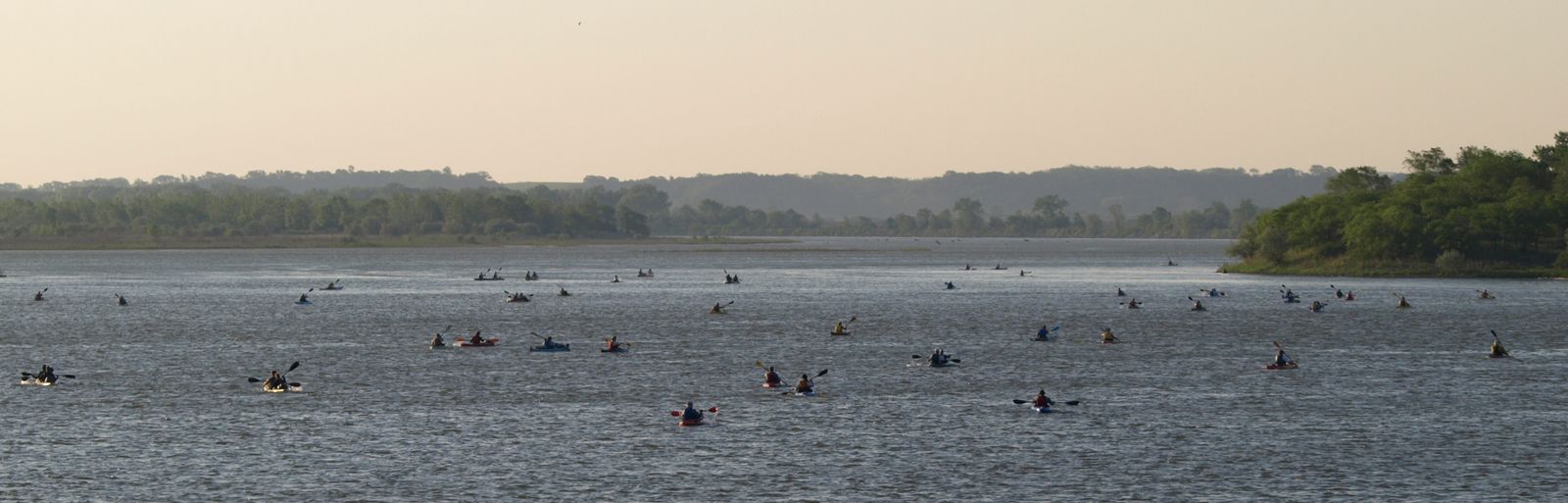
 On May 29th over 100 paddlers descended upon Yankton , a small city in southern South Dakota, bringing with them 77 canoes and kayaks of various size and style. The people were there for the inaugural South Dakota Kayak Challenge, a 75 mile race along the Missouri River ending in Sioux City Iowa. The race brought competitors from around the American Mid-west, representing 9 states and us, a lone boat from Canada.
Our SDKC journey began with a 2000km (1250mi) drive. We left Calgary the evening of June 27th in the midst of a rain/snow combo. The trip took us across Alberta and east into Saskatchewan where we crossed into North Dakota at the North Portal Saskatchewan border crossing as the first daylight came over the horizon. We continued east to Fargo ND which is just west of the Minnesota state border, then turned down I-29 and arrived in Yankton SD a mere 23.5 hours after leaving Calgary. In fact, we were a little late and missed part of the mandatory safety meeting. When we arrived, we were greeted with 22C weather and sun, a far cry from the near winter conditions we left Calgary in. As we exited the car, we took note of the boats that were already at the campsite. Most notably we took an inventory of the canoes there (since that is what we were in), a couple of Wenonahs (Jensen, Minnesota II) and a few carbon fibre 20" boats. Lined up among the canoes were many kayaks (massinvely outnumbering the canoes). Current Designs, Surfskis and Pelicans among many others. After catching the last of the safety meeting, we checked in, received our shirts and pulled our 16' Clipper Prospector (racing and prospector - two words the do not go together, but our racing boat is in Texas being fitted for the Safari in two weeks time) off the car and prepared our tents for an early night, afterall the race started at 7:00am sharp.
By 5:45am on race day, a vast majority of people were up. Riverside park in Yankton was abuzz w ith people having breakfast, taking down their camps and moving boats to the starting beach. By ten to seven, almost all the boats were lined up on the shore and the competitors made the last minute preparations to their boats and awaited the US Military to fire the starting gun (after all it was the Memorial Day weekend). At 7:00am sharp two soldiers fired their rifles to signal the start of the first ever South Dak
 ota Kayak Challenge. Within seconds the Missouri river was alive with activity as boats slipped into the river and began the journey to Iowa, passing through 4 checkpoints along the way. In all seriousness, only a few boats had a chance to win the race, and these boats separated themselves fairly quickly from the pack. By mile 10 about 15 boats had separated themselves from the entire pack.
 ith people having breakfast, taking down their camps and moving boats to the starting beach. By ten to seven, almost all the boats were lined up on the shore and the competitors made the last minute preparations to their boats and awaited the US Military to fire the starting gun (after all it was the Memorial Day weekend). At 7:00am sharp two soldiers fired their rifles to signal the start of the first ever South Dak
 ota Kayak Challenge. Within seconds the Missouri river was alive with activity as boats slipped into the river and began the journey to Iowa, passing through 4 checkpoints along the way. In all seriousness, only a few boats had a chance to win the race, and these boats separated themselves fairly quickly from the pack. By mile 10 about 15 boats had separated themselves from the entire pack.
The first 30km (19mi) seemed to fly by as we were surrounded by boats, specifically three other boats that we seemed to pass, just to  have them pass us and we would then pass them again, this went on for the vast majority of the race. Ti first thing we noticed was that the Missouri River (unlike the Red Deer and Bow in Alberta) was deep enough in most places to get a full stroke into the water, something that we've sadly been missing in our practices. This made the ease of paddling easier and the stroke much more efficient as we could get the vertical motion needed to drive the canoe forward. T he only time this didn't occur for any distance was a small 1km stretch just before checkpoint 2 where we opted to go around a lrage sandbar to the east. Two kayaks went to the west and passed us. By the time we reached checkpoint #2, the fastest boats really pulled away and we could barely see them on the horizon and four boats made up the "chase group", comprised of 2 kayaks, one 20' carbon fibre/kevlar canoe and our little prospector chugging away at an average speed of 11.6kph (7.2mph) we had our GPS rigged. Unfortunately that would not last long, by mid-day the wind had started to pick up and soon we found ourselves paddling into 20-30mph headwinds, virtually negating the current. In fact some paddlers told me when they stopped, the wind would actually blow them upstream against the current. It was this wind that caused most the problems. By 2:00 about 6 boats had already dropped out, by 5:00 I was told that number had increased to the double digits, by the end of the race, 23 boats would succumb to the wind and distance.
 have them pass us and we would then pass them again, this went on for the vast majority of the race. Ti first thing we noticed was that the Missouri River (unlike the Red Deer and Bow in Alberta) was deep enough in most places to get a full stroke into the water, something that we've sadly been missing in our practices. This made the ease of paddling easier and the stroke much more efficient as we could get the vertical motion needed to drive the canoe forward. T he only time this didn't occur for any distance was a small 1km stretch just before checkpoint 2 where we opted to go around a lrage sandbar to the east. Two kayaks went to the west and passed us. By the time we reached checkpoint #2, the fastest boats really pulled away and we could barely see them on the horizon and four boats made up the "chase group", comprised of 2 kayaks, one 20' carbon fibre/kevlar canoe and our little prospector chugging away at an average speed of 11.6kph (7.2mph) we had our GPS rigged. Unfortunately that would not last long, by mid-day the wind had started to pick up and soon we found ourselves paddling into 20-30mph headwinds, virtually negating the current. In fact some paddlers told me when they stopped, the wind would actually blow them upstream against the current. It was this wind that caused most the problems. By 2:00 about 6 boats had already dropped out, by 5:00 I was told that number had increased to the double digits, by the end of the race, 23 boats would succumb to the wind and distance.
Over the last 32km (20 mi), the wind really played havoc with our speed. Our shourt, wide flat bot tomed boat with no skirt scooped the wind and pushed us back. Coupled with the biggest challenge of the race - drunker recreational boaters purposely causing wakes - some over 3' tall) our speed fell to an average of 7.8kph (4.5 mph) for a total race average of 9.2 kph (5.7mph). After pulling into Bev's at 6:51pm we were both feeling pretty good - especially after we were told we were 7th overall and first in our division. We took a quick swim in the water - jumping off the pier (once on purpose, the other by accident) then went and sat down for dinner with some fellow racers, such as Bryan who won overall in just over 10 hours. Bryan talked to us of the Missouri 340 and really stolked our interested, perhaps next year, but definately we'll be in a much better boat, perhaps a Jensen or something similar. This year we have to focus on the Water Safari in Texas in a few weeks therefore a trip to Kansas City is sadly not in the budget.
 tomed boat with no skirt scooped the wind and pushed us back. Coupled with the biggest challenge of the race - drunker recreational boaters purposely causing wakes - some over 3' tall) our speed fell to an average of 7.8kph (4.5 mph) for a total race average of 9.2 kph (5.7mph). After pulling into Bev's at 6:51pm we were both feeling pretty good - especially after we were told we were 7th overall and first in our division. We took a quick swim in the water - jumping off the pier (once on purpose, the other by accident) then went and sat down for dinner with some fellow racers, such as Bryan who won overall in just over 10 hours. Bryan talked to us of the Missouri 340 and really stolked our interested, perhaps next year, but definately we'll be in a much better boat, perhaps a Jensen or something similar. This year we have to focus on the Water Safari in Texas in a few weeks therefore a trip to Kansas City is sadly not in the budget.
Unfortunately we couldn't stay for the awards ceremony the next day. We rigged our canoe for the 1600 km (1000 mi) drive back to Ca lgary (we were to go through Wyoming and Montana this time). At 10:30pm or so we started our trip back to Canada, having said bye to event organizers Jarett and Stephen and several other racers that we met along the way. We decided this is definately an event that we will likely be back to again
 , it was organized great and the hospitality was quite amazing. Kudos to all that helped organize such an event and have it run so smoothly. I am sure everybody, regardless of how they finished, enjoyed themselves and the event. On Monday morning just before leaving South Dakota, we pulled over at a rest stop and had a quick awards ceremony of our own, more of a keepsake picture more than anything.
 lgary (we were to go through Wyoming and Montana this time). At 10:30pm or so we started our trip back to Canada, having said bye to event organizers Jarett and Stephen and several other racers that we met along the way. We decided this is definately an event that we will likely be back to again
 , it was organized great and the hospitality was quite amazing. Kudos to all that helped organize such an event and have it run so smoothly. I am sure everybody, regardless of how they finished, enjoyed themselves and the event. On Monday morning just before leaving South Dakota, we pulled over at a rest stop and had a quick awards ceremony of our own, more of a keepsake picture more than anything.
We arrived back in Calgary at just after 1:30am Monday May 31st, tired but excited that we had just accomplished a race after 24 hours of driving and very little sleep each. It truly is amazing how far your body can be pushed if you are determined to finish something. As a side note, it was joked that we currently hold the Canadian Record for the SDKC, albeit not a good one and only because we are the only Canadian boat to take part, but hey, why not live it up while we can right?
Hope to see you again next year SDKC. Keep me informed Jarett and Stephen.
Next up, 262 miles of the Texas Water Safari - June 12, 2010
Tuesday, May 18, 2010
Texas Water Safari -The First 100km
Have you ever wondered what the Texas Water Safari was like? The next few installments of the blog will breakdown the race, providing you an opportunity ro understand the race better and what the participants go through.
On Saturday June 12th at 8:50am, over 100 boats will put into the water at Aquarena Springs in San Marcos Texas and pull into their starting positions. For the next 10 minutes, the armada of canoes and kayaks will gently bob in Spring Lake. The temperature will already be in the mid 20C (75F) range and the humidity will be rolling in.
At 9:00am, a single gunshot will send over 250 paddlers thrashing across the lake, crashing into each other and jostling for position en route to Joe's Crab Shack Dam a mere 400m (1/4 mi) away. Once the boats have traversed the little lake, the paddlers will jump out into the mud and water and start a downhill running portage through dense bush, roots, sharp rocks and other racers. Hazardous rocks threaten to twist ankles, tear flesh and damage boats en route to the mouth of the San Marcos River, a river that will take them to the Guadalupe River, out into the Gulf of Mexico and onto Seadrift 421km (262 mi) away, and that is just the first kilometre of the race.
Over the next 3.5km (2.2mi) there are two more dams and 3 portages (2 mandatory). The Rio Vista Dam, a mere 1.2km (0.75 mi) from the race's beginning provides a opportunity to run the small spillway if you don't feel like portaging, however, many boats that attempt are thwarted in their effort and end up capsized with their paddlers scrambling to catch their boat and gear as it floats down the river and then upright it so the can continue as the spillway descends into a 4ft (1.3m) standing wave
In fact, this section of the river is often considered the most difficult part of the race. Aside from the 7 portages, 4 low clearance bridges and 2 rapids, this section contains what is locally known as the "Gnarly 40". Forty miles (64km) of tight, tree clogged and log jammed river channel between Staples Dam and Palmetto State Park. In years of high water, log jams can be nearly a mile long, being unable to paddle them the racers have to traverse across the log jam with their canoe and gear, being careful not to breakthrough or have their boats swept underneath. These "logjam portages" often take more than one trip eating up valuable time. These trees are also prime habitat for black widows and cottonmouth snakes, both highly venomous.
This section also contains the Cottonseed Rapids, a long stretch of rocks and white water with a narrow chute exit which is a favourite spot for many spectators. Many boats that attempt to run this section are swept into rocks, paddlers are tossed from boats, canoes and kayaks capsize and fill with water and gear is swept downstream, if lucky the boats sustain no damage and the paddlers can meet up with their boats and gather their gear further down. Those that are not lucky can find their boats pinned or even rupture their hulls which can either end their race a mere 16km into the race or spend critical time repairing the damage which can be moderate or severe taking up to an hour to repair. Boats pinned to rocks by the force of the water often find themselves in the way of boats shooting the rapids and can cause significant collisions.
If that wasn't enough, the portage at the Ottine Dam is considered one of the hardest by many racers in this race. Due to the strong current of the dam, you must pull over well above it or face the chance of being swept over, you then must pull the boat out of the water and up a steep slick river bank and down a slippery clay slope covered in dense trees, prime location for poison ivy, fire ants, and venomous snakes and spiders, a bite from either can prove fatal to a human in an exhausted and stressed state. Not to mention prime real estate to drop a canoe or injure oneself.
To top it off, racers have to finish this section by 10AM Sunday, a mere 25 hours after the race starts.
This is the first 100km of the Texas Water Safari, "The World's Toughest Boat Race". Stay tuned for the second 100km.
On Saturday June 12th at 8:50am, over 100 boats will put into the water at Aquarena Springs in San Marcos Texas and pull into their starting positions. For the next 10 minutes, the armada of canoes and kayaks will gently bob in Spring Lake. The temperature will already be in the mid 20C (75F) range and the humidity will be rolling in.
At 9:00am, a single gunshot will send over 250 paddlers thrashing across the lake, crashing into each other and jostling for position en route to Joe's Crab Shack Dam a mere 400m (1/4 mi) away. Once the boats have traversed the little lake, the paddlers will jump out into the mud and water and start a downhill running portage through dense bush, roots, sharp rocks and other racers. Hazardous rocks threaten to twist ankles, tear flesh and damage boats en route to the mouth of the San Marcos River, a river that will take them to the Guadalupe River, out into the Gulf of Mexico and onto Seadrift 421km (262 mi) away, and that is just the first kilometre of the race.
Over the next 3.5km (2.2mi) there are two more dams and 3 portages (2 mandatory). The Rio Vista Dam, a mere 1.2km (0.75 mi) from the race's beginning provides a opportunity to run the small spillway if you don't feel like portaging, however, many boats that attempt are thwarted in their effort and end up capsized with their paddlers scrambling to catch their boat and gear as it floats down the river and then upright it so the can continue as the spillway descends into a 4ft (1.3m) standing wave
In fact, this section of the river is often considered the most difficult part of the race. Aside from the 7 portages, 4 low clearance bridges and 2 rapids, this section contains what is locally known as the "Gnarly 40". Forty miles (64km) of tight, tree clogged and log jammed river channel between Staples Dam and Palmetto State Park. In years of high water, log jams can be nearly a mile long, being unable to paddle them the racers have to traverse across the log jam with their canoe and gear, being careful not to breakthrough or have their boats swept underneath. These "logjam portages" often take more than one trip eating up valuable time. These trees are also prime habitat for black widows and cottonmouth snakes, both highly venomous.
This section also contains the Cottonseed Rapids, a long stretch of rocks and white water with a narrow chute exit which is a favourite spot for many spectators. Many boats that attempt to run this section are swept into rocks, paddlers are tossed from boats, canoes and kayaks capsize and fill with water and gear is swept downstream, if lucky the boats sustain no damage and the paddlers can meet up with their boats and gather their gear further down. Those that are not lucky can find their boats pinned or even rupture their hulls which can either end their race a mere 16km into the race or spend critical time repairing the damage which can be moderate or severe taking up to an hour to repair. Boats pinned to rocks by the force of the water often find themselves in the way of boats shooting the rapids and can cause significant collisions.
If that wasn't enough, the portage at the Ottine Dam is considered one of the hardest by many racers in this race. Due to the strong current of the dam, you must pull over well above it or face the chance of being swept over, you then must pull the boat out of the water and up a steep slick river bank and down a slippery clay slope covered in dense trees, prime location for poison ivy, fire ants, and venomous snakes and spiders, a bite from either can prove fatal to a human in an exhausted and stressed state. Not to mention prime real estate to drop a canoe or injure oneself.
To top it off, racers have to finish this section by 10AM Sunday, a mere 25 hours after the race starts.
This is the first 100km of the Texas Water Safari, "The World's Toughest Boat Race". Stay tuned for the second 100km.
Monday, May 17, 2010
100 Kilometres Of The Beautiful And Weir-d Bow River
 This was a big weekend for Team Chinook, it marked the two week countdown to the inagural South Dakota Kayak Challenge and four weeks to the Texas Water Safari. It was also the second 100km (61 mile) trial run for Team Chinook and the first in temperatures exceeding 20C. It was also our first practice run where anybody with internet access could track our progress virtually live through our SPOT unit, as we paddled the world famous Bow River from Bowness Park in Calgary to Carseland Alberta.
Being mid
 -May, the water level in the Bow is still relatively low, as such the flow volume is low and the speed is slower than normal. This section of the Bow offers relatively little in the realm of dangers for paddlers and is very straigh forward, there are a few class 1+ rapids and numerous ripples. The only real dangers are the two weirs that are along the way, on in downtown Clagary and one just to the east as you enter Carseland. Each providing a mandatory portage due to their trecherous hydraulics. I've heard and read before that the weir in Calgary is responsible for a number of deaths, one of them not to long ago. As you approach both weirs, signs warn you of the danger ahead and a string of bouys delineates the safe zone from the danger zone.
The weirs were created for aeration and diversion of water to irrigation
 channels and produce an amazing hydaulic cycle that if you get caught it, it would be impossible to get out of. It also provides a habitat for pelicans as they wait in the wake of the water looking for fish that get swept over. Due to the construction of Harvie Passage in Calgary and the removal of the Weir, we ended up having an 800m portage, although I must admit that it was an easy one, along the Bow River Bike Path. We did run into an older gentleman who was familiar with the Texas Water Safari through readings and wished us luck.
Below the construction, the water level dropped dramatically not even allowing us to get the entire blade of the paddle into the water, after a few hundred metres the water deepened, then would shallow out again. This pretty much was the course for the rest of the urban paddle. As we approached south Calgary we finally found life in the river, people were out at the dog park and the fly fishers were out in full force. We managed to see some impressive trout being reeled in, one was easily in the range of 24 inches, which to me is a big fish.
Over the next 30km (18 miles) we passed easily two dozen fishing boats and easily twice as many fly fishermen/women than we did boats. It was our first time having to share the river with watercraft or person this year, and from our numerous and brief conversations, it was many of these people's first times out as well. Its amazing what happens once the temp hits the mid teens.
After running a few class 1+ we were greeted by a big white warning sign telling us to sta y to the left channel to avoid the weir in Carseland and prepare for a mandatory portage. At this point our average speed fell from 10kph even to about 3 as we had to exit the boat numerous times to ferry it through shallows, rock gardens and wet gravel bars. Thankfully after 40 minutes we were at the portage and the end of our route. Total time was 9 hours and 32 minutes and total distance was 101km (61 miles) for an average moving speed of 9.9kph (6.1 mph), providing a food warm up to next weekends timed 360km (225 mi) practice run.
 y to the left channel to avoid the weir in Carseland and prepare for a mandatory portage. At this point our average speed fell from 10kph even to about 3 as we had to exit the boat numerous times to ferry it through shallows, rock gardens and wet gravel bars. Thankfully after 40 minutes we were at the portage and the end of our route. Total time was 9 hours and 32 minutes and total distance was 101km (61 miles) for an average moving speed of 9.9kph (6.1 mph), providing a food warm up to next weekends timed 360km (225 mi) practice run.
Sunday, May 2, 2010
A Game Of Inches And Ounces
 If you wanted to win or even be competitive in the Boston Marathon, would you wear a 25lb (11kg) backpack and 3lb (1.5kg) hiking boots? My guess is that you probably wouldn't, you'd probably opt for light shorts, light comfortable runners that provide contorsional support and maybe a ball cap to keep the sun off your head. As a runner, you'd try to be as light and efficient as possible. Ultramarathon canoe racers and runners actually have that in common.
Outside of technique and physical endurance, canoe racing over extremely long distances is a game of inches and ounces, a race where when you look at the physics, you can reap major benefits from minor sacrifices.
A MATTER OF INCHES
All other dimensions equal and paddling being equal, which canoe do you think will be faster, a canoe with a 17' waterline or a canoe with a 16' waterline?
The fact is, what many people (recreational canoeists included) don't realise, is that if you have a canoe with a longer waterline, you will actually have a faster theoretical maximum speed compared to a canoe with a shorter waterline. Let's look at a boat with a 17' waterline (Canoe A) and a canoe with a 16' waterline (Canoe B).

Without actually deriving the formula, the equation to determine the theoretical maximum speed of a canoe/kayak in miles per hour (mph) is 1.55 x SQRT(wl) where wl is the waterline length in feet.
Boat A: 1.55 x SQRT(17) = 6.4 mph (10.29kph)
Boat B: 1.55 x SQRT(16) = 6.2mph (9.97kph)
This may not sound like a lot, a mere 0.2mph (0.32kph), but over 1 hour, that amounts to a distance of 350 yd (320m) or almost a 2 minute lead. In typical marathon races that take 5 to 6 hours to complete, that distance can increase to 1mi (1.6km) and be a time of 10 -15 minutes. In an ultramarathon race such as the Texas Water Safari, over a time of 80 hours, the difference in distance can be 16 miles (25.6km) and a difference between boats of almost 2.5 hours. This scenario is of course under optimum conditions with a zero-sum flow and not accounting for fatigue.
However, races are never under optimum conditions and fatigue is something that everybody has to deal with as well as the fact that with each stroke, the canoe is pulled/pushed forward, but unfortunately the power from each stroke is applied off-centre at an angle to the centreline as such, the canoe will not track perfectly straight as energy is lost and distance is gained as the canoe angles off centre. So what can you do to minimize lost energy?
A MATTER OF OUNCES
Without changing to a canoe with a minimal rocker or keeping synchronized and equal power strokes, you can mitigate energy loss and thus increase endurance by shedding weight, and the weight doesn't have to be much.
If you opted for a carbon fibre paddle that weighed a mere 6 ounces over a wooden paddle weighing 1 8 ounces, you would find yourself lifting 12 ounces less per stroke. But these 12 ounces equate to 2,025lbs (919kg) less per hour. Over a typical 5 hour race you would be lifting 10,125lb (4,595kg) less. In the Texas Water Safari, a boat finishing in 80 hours would lift an astonishing 810,000 lbs (367,600kg) less.
 8 ounces, you would find yourself lifting 12 ounces less per stroke. But these 12 ounces equate to 2,025lbs (919kg) less per hour. Over a typical 5 hour race you would be lifting 10,125lb (4,595kg) less. In the Texas Water Safari, a boat finishing in 80 hours would lift an astonishing 810,000 lbs (367,600kg) less.
One of the better ways though, is to actually have the racer lose weight. If a paddler gearing up for a race can lose a mere 5lbs, over the course of 1 hour and holding 45 strokes per minutes, the paddler will be pulling 13,500lb (6,124kg) per hour. Over a 5 hour race that's 67,500lbs (30,620kg) and a boat finishing the Texas Water Safari in 80 hours would be pulling 1,080,000lbs (489,900kg) less through the water. That's over 1 million pounds.
This weight savings also comes into play when portaging, lifting the boat over log jams and of course minimizing friction. As more weight is placed into a boat, it sits lower in the water causing greater displacement of water and greater friction, meaning more force (and energy) is needed to move the boat. If you want, you can calculate the force needed to move a boat of different weights by using the following equation. Rf = 0.97 x Cf x Sw x V^2 where Rf is Resistance in lbs, Cf is the friction co-efficient, Sw is the wetted surface, V is the velocity is feet per second and 0.97 is the fresh water constant.
This weight reduction can be added to almost any aspect of gear you can think of taking, from sleeping pads, to pfd`s, to food. And don`t worry, we`re keeping all this in mind as we prepare for Texas.
Friday, April 30, 2010
Announcing Two New Sponsors
 With only 42 days before I embark on the World's Toughest Boat Race, I am proud to announce that Spirit West Outdoor And Adventure Store has agreed to become an official sponsor of Team Chinook. Spirit West is a store specializing in outdoor adventure and are one of the largest carriers of Mammut and Navarro in Calgary as well as in-store outdoor books and maps. Spirit West will be contributing specifically designed and measured dry-bags that will be function as a back-pack. Having looked at the prototype, these bags will be fast to put on and fast to take off and will benefit in long portages by removing weight from the canoe. The padded straps and adjustible hip belt will provide stability when running with a canoe overhead. Created from a lighter-weight rugged vinyl, these dry-bags will be able to withstand scraping, pulling, and tugging that foliage of rough portages can provide.
They will also be providing lightweight, gusseted, fast drying white leggings that we will wear during the race. These leggings will be made of a high-performance microfibre-polyester material and will prevent sun-burns. The colour will provide a cooling effect as light will be reflected as opposed to absorbed by the fabric and the fast dry-ing action/fast wicking, will ensure that we remain comfortable. The gusset will provide a more natural fit and will help increase mobility when we are on land.
Spirit West is responsible for presenting the Calgary Outdoor Festival as well as providing an online community for adventurers and outdoor enthusiasts. Although mainly local to Calgary and Southern Alberta, Outdoorspirit.ca site provides blogs, forums, user-entered trail reports as well as an online gear swap.
 I am also pleased to announce that Out There has agreed to help Team Chinook. They have donated two Thermarest Neo-Air sleeping pads to minimize weight and bulk during the race. The Neo-Air is the world's lightest sleeping pad available (weighing just 14 oz while being 2.5 in thick). The patent-pending internal triangular core matrix creates an internal truss system that produces the most stable inflatable mattress allowing you to sleep on uneven terrain and not be kept awake by twigs and little stones. When we are done our few short naps, the Neo-Air will pack down to the size of a 1L (1 quart) water bottle an be virtually invisible while canoeing.
Started by Jamie Clarke (Professional Adventurer and Everest Summiter) Out There has grown to have the largest selection of the premier outdoor brands such as Arc'Teryx, North Face and Mountain Hardwear in Calgary. It is also the home of liveoutthere.com, a growing online community of avid adventurers from around the world providing live updates, stories, photo albums and videos of their travels via integrated twitter, facebook and login features as well as soon to come gear reviews and contests.
I would ask everybody to check out the two communities that these companies offer and if you are ever in Calgary and need gear. These two stores come highly recommended from me for their levels of professionalism and quality of gear.
42 days until the start of the 2010 Texas Water Safari.
Wednesday, April 21, 2010
A Tale Of Two Practices
 The past two practices were met with varying degrees of success. Our April 11th training run was supposed to take us 40 km (25 mi) from Ghost Dam to Bowness Park in Calgary. This is a fast moving river with currents in some places as fast as 4kph (2.5 mph) and involves a few ripples, a small step and a fun small class II wavetrain. In fact it is this little class II that made us decide to run this section - we plan to run the slipway at the Rio Vista dam along the race. Its a place where a vast majority of boats that attmpt to run, flip.
The day started off as any early April day in Southern Alberta would. A nippy -5C (23F) morning greeted us. By the time we reached Cochrane the temp had warmed up to a balmy -2C (28.5F). Donning an extra layer of leggings and a chillguard we portaged the canoe down the old washed out road, dropping about 35m (115 ft) over a distance of about 500m (1650 ft). When we put the canoe in the little bay beside the dams outlet, there was still ice on the surface of the water (due to it being standing water) and the water temperature being a fraction of a degree above freezing. As we pushed out - breaking ice like an arctic icebreaker) the sun decided to pay us a visit, and soon we reached the high of 4C (39.2F) that was being called for. Unfortunately this didn't last long. Within 8km (5mi) the temperature dropped back below freezing, the sun disappeared and the winds from the rockies was beginning to bear down on usm magnified by the river valley.
Having run every wave train, both Tyler and I were soaked. Within 5km (3.1mi) from Cochrane (the half-way point) headwinds were in around the 30kph (18.5 mph) and the temperature without windchill had dipped to -9C (15.8F), wind generated whitecaps all around us. When using a windchill calculator those conditions equate to a temperature of -19C (-2F) - severe hypothermia conditions. We decided with reason this time and pulled out in Cochrane, cold, wet without a ride and still 22km (13.5mi) short of our original goal of Calgary. Suffice it to say, we didn't finish this leg, we chalked it up to resostence training in the wind and the asked ourselves this one question: We have to go to Texas and race in there hot conditions..but how would a Texan or Belizan coming to Canada deal with our paddling conditions for a race? That's some food for thought.
Now fast forward to this past weekend. Having been shut-down early the previous run, Tyler and I decided to make this practice count. we had only done 45km (28 mi) in the previous two runs combined and we knew we were nearly 2 months behind on other teams, so we decided to make a run from Content Bridge to Drumheller - a total distance of 122km (76mi). Having never run this section of the river and having temperatures predicted to be in the 20C (68F) range, we allotted ourselves 17 hours to finish, meaning we would have to travel an average of 7.2 kph (4.4 mph), something that should be attainable on a river flowing about 1.7kph (1 mph).
Again as we woke up, had breakfast and took the 40 minute drive to the put-in we were greeted with a brisk -1C (35F), but with no cloud in the sky and no frontal movement, we kn
 ew it was going to get much warmer. Into the water at 8:30 and we were on our way, along a route that would take us from the aspen forests to the heart of the Canadian Badlands. This trip also provided us an opportunity to try out or TWS diet: Boost Meal Replacements, Nuun Electrolyte Tablets and misc. bars and jerky, the Nuun tablets proved to be key to replenish and keep us hydrated. The Red Deer River here is fairly wide, shallow and slow moving, except in a few places where the gradient steepens and the one short class II, from what I understand its similar to the Guadelupe (minus the shallowness). As we entered the Badlands we felt compelled to pull out and have a snack amongst the coulees, hoodoos and other badland terrain, and under the early spring desert sun. We also decided to rig up or lighting system for the night part of the paddle, which consisted of two 6-volt I-Beams...which without going into too much detail, failed about 4 hours after being turned on. So our night navigation was put to use - back to the drawing board on that configuration. The night wnet fairly uneventful, we paddled 95km (60km) before nightfall then another 27km (16 mi) at night. We ended up pulling into Drumheller 16 hours and 16 minutes of paddling time after we started.
Being the first long run of the season and equal to 2/7ths (28%) the Texas Water Safari, we were happy with our finishing time, but we also both recognized that we could probably shave an hour off that time with slightly more efficiency, but that is what practicing is about. I ended up sleeping about 2 hours after getting out of the boat and going to bed at 10:00PM Sunday.
Stay tuned as this is going to be a busy week, I'll not be practicing this weekend as its my Anniversary, but the weekend following we are planning a 200km (125mi) trial run.
GO TEAM CHINOOK!!!
Wednesday, March 17, 2010
How's The Water Up There?
 So I'm going to pose a question to you. What do you do when you are 2 months behind on training and counting with one of the hardest endurance and adventure races in the world looming less than 3 months away?
While our southern counterparts have been canoeing in preparation for the TWS for the past few weeks, or in some cases months, we've been in the grips of winter with an average temperature from December 16th 2009 to March 16, 2010 of - 11C. Mild by winter standards, but still cold enough to freeze water fairly quickly.
In fact, up to three weeks ago, the Bow River running through Calgary was fairly covered in ice, but over that time temperatures have been well above seasonal, setting record highs three times now we are seeing some quick progress in the thawing process. Unfortunately, not all rivers are at the same stage of opening up.
This past weekend my wife and I drove up to Edmonton to relocate a domesticated painted turtle to a co-worker. Along the way we drove over the Red Deer river. Now, Red Deer is a mere 150km north of Calgary, yet the river showed no signs of thaw. Ice coverage was 100% and I could have probably walked from one side to another without much worry of breaking through. This poses a bit of a logisitcal hurdle for our training as the Red Deer river is to be the staging ground for our endurance training, the reservoirs being flat water are still further behind the rivers.
and get out sooner? I can't say that hasn't been ruled out yet, but what we have to remember is that the Bow River is a mountain fed river, meaning that even though it is open, its flowing at a quick pace, in some places I'd estimate the flow to be close to 10kph (7 mph). Add to that an average temperature of likely less than
 2C (5F) and abrupt ice bridges we have a recipe for disaster. It gets really frustrating knowing that you are doing all you can in the gym, but reading about other teams who are in the water already. This makes you question how your performance will stack-up, but I remain optimistic, I've been sticking to a regimented work-out, increasing my endurance, and testing my body in different states of fatigue. But cue Yoda to remind me "there is another."
Lake Okanagan, nestled in the beautiful Okanagan Valley of B.C. is a large, deep, glacial relic of a lake. It measures 145km (90 mi) in length and in some places 5km (3 mi) in width...and it never freezes. Okay, maybe not never, but I think it has only frozen over twice in the past 150 years or so, and the lake is only 600km to the west. Yes, sadly, the only place that is paddleable is a 7 hour drive through the Canadian Rockies. Now for the good news, this month ends in a long weekend and I already have confirmed free room and board in Kelowna, so the only hurdle that exists is finding a canoe to rent at this time of year. With the weather in Kelowna being above normal this year and the water being fairly calm, the lake becomes very enticing.
Whatever happens in the next little bit, there are signs all around that dry-land training is slowly coming to an end. Both my partner and I have agreed that when the waterways of Alberta become navigable, we'll have to be out every weekend to compensate for our glaring major disadvantage...a below freezing winter.
Now my answer to the original queston: Train harder, keep positive and don't sweat the little things. When the time comes that you get into water, you'll find your other training will have helped dramatically.
Saturday, March 13, 2010
The Road To Texas - 3 Months To Go
 Last spring I announced that I was going to participate in this years Texas Water Safari, a 421-kilometre (262-mile) ultramarathon canoe race from central Texas to the Gulf of Mexico. That was 292 days ago, and now today, the Texas Water Safari looms a mere 3 months away, a paltry 92 days.
For those unfamiliar with the Texas Water Safari (TWS for short), it is, as stated above a 421-kilometre (262-mile) ultramarathon canoe race. The race starts in the central Texas town of San Marcos and follows two rivers (the San Marcos and Guadalupe) to the Gulf of Mexico. Along the course, paddlers will encounter and have to negotiate around venemous snakes, venomous spiders, alligators, carniverous fish, fire ants and portages through poison ivy infested foliage. T hat doesn't include the battling of physical and mental exhaustion, capsized canoes, log jams upwards of 1.5 kilometres (1 mile) long and paddling through the summer Texas sun.
Did I mention that the TWS is ranked as the 6th toughest race in the world by Peak 100?
So the realisation that there isn't much time left has finally set in, other teams in our division have been canoeing or even racing for the past few weeks or even months. But with our waterways finally beginning to open, hopefully out dryland training will be coming to an end. Being out in the mountains all winter workin on cardio can only get you so far, you need that water component, soon, we will have it, and then training will really take off.
Stay tuned everybody, only 92 days left until the Texas Water Safari. Go Team Chinook!
Subscribe to:
Posts (Atom)